Managing state and memory in AI products requires all three disciplines: AI PM defines how long conversations should remain coherent and what memory patterns users expect; Vibe-Coding prototypes different memory architectures to test which create the best user experience; AI Engineering implements the actual state management, session handling, and workflow orchestration that make stateful AI products work.
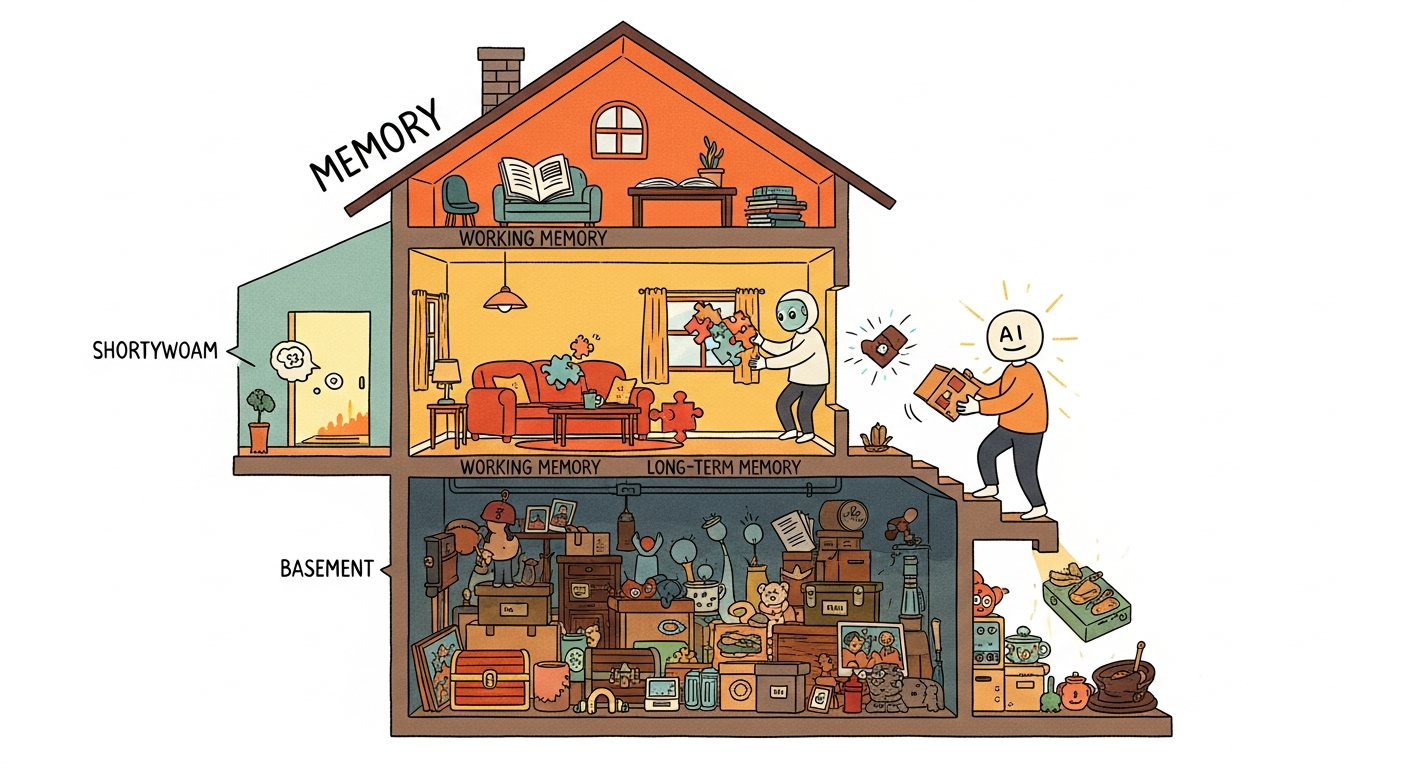
Vibe-coding enables rapid testing of memory patterns and state management strategies. Quickly prototype different session memory approaches, test how context accumulates errors over time, and explore agent handoff behaviors under various scenarios. Vibe-coding memory patterns reveals failure modes like context drift, memory corruption, and state inconsistency before they become production problems.
PM decisions around state include: How long should conversations remain coherent to users? What happens to user data across sessions? When should context be retained versus forgotten? For multi-step workflows, PMs must define what constitutes a "complete" task and how long partial progress remains valid. These choices affect privacy, storage costs, user experience expectations, and the perception of AI as reliable versus flaky. Memory decisions are often irreversible from a user trust perspective.
Objective: Learn patterns for state management, memory, and workflow orchestration in AI applications.
Chapter Overview
NEW content. This chapter covers memory patterns, state management, workflow orchestration frameworks, and patterns for building stateful AI applications.
Four Questions This Chapter Answers
- What are we trying to learn? How to build AI applications that maintain appropriate state across interactions without accumulating errors or losing context.
- What is the fastest prototype that could teach it? A conversation flow prototype that tests session memory, user memory, and agent handoff patterns in a realistic scenario.
- What would count as success or failure? Stateful AI applications that handle context appropriately across sessions without memory errors compounding over time.
- What engineering consequence follows from the result? Memory and state management require explicit architectural patterns; treating AI state as simple is a common source of subtle, damaging bugs.
Learning Objectives
- Design memory patterns for AI applications
- Manage state in probabilistic systems
- Use workflow orchestration frameworks
- Build conversation flows