"You cannot debug what you cannot see. In AI systems, observability is not optional. It is the foundation of every reliability practice."
A Site Reliability Engineer
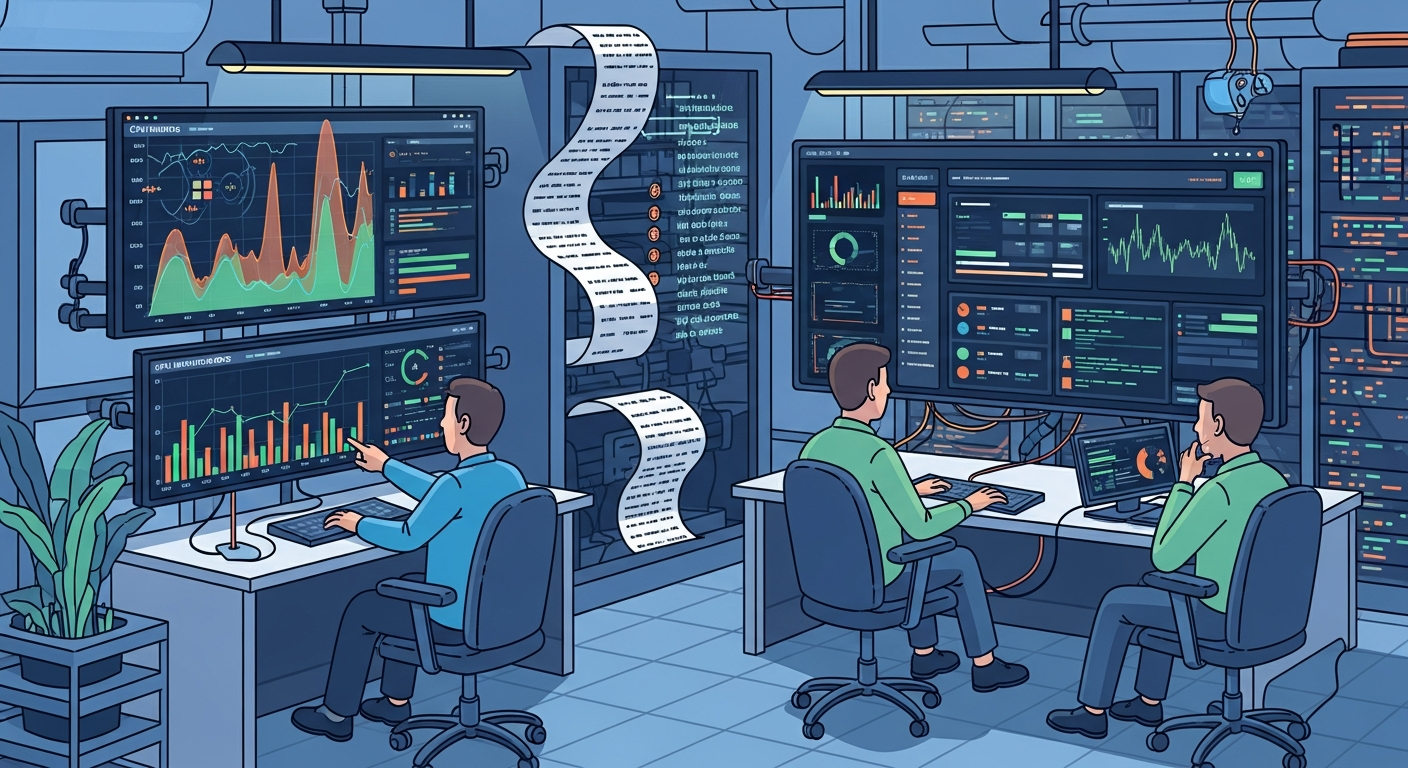
Observing AI systems requires all three disciplines working together: AI PM identifies what behaviors matter to track and what alerts indicate user-facing problems; Vibe-Coding explores different failure modes to understand what could go wrong and how to detect it; AI Engineering implements the tracing, logging, and monitoring that make debugging possible.
Use vibe coding to rapidly prototype observability solutions before building full instrumentation. Test different tracing approaches, experiment with span-level diagnostics, and explore what data you actually need versus what seems useful in theory. Vibe coding observability prototypes helps you understand which signals matter for your specific AI behaviors, avoiding over-instrumentation that adds cost without insight.
When debugging AI behavior, first create a minimal eval that reproduces the failure. Use vibe coding to rapidly generate test prompts that trigger the problematic behavior, then systematically narrow down the cause. Building quick reproduction evals is faster than extensive manual investigation.
Objective: Master observability tooling, debugging techniques, and failure analysis methods specific to AI systems, so you can diagnose issues quickly and maintain reliability in production.
Chapter Overview
This chapter covers the full observability stack for AI products. You learn how to implement tracing that captures the AI request lifecycle, inspect prompts and tool calls to understand model behavior, debug retrieval failures that cause RAG systems to fail, and conduct thorough postmortems that prevent recurrence. These techniques apply to every AI system regardless of the underlying model or framework.
Four Questions This Chapter Answers
- What are we trying to learn? How to diagnose AI failures in production when traditional debugging approaches do not work.
- What is the fastest prototype that could teach it? Tracing a single user complaint through your AI system to see what observability data reveals versus what remains opaque.
- What would count as success or failure? Ability to answer "why did the AI do that?" with evidence rather than speculation.
- What engineering consequence follows from the result? Observability infrastructure must be built before you need it; debugging AI failures without it is slow and expensive.
Learning Objectives
- Implement AI-native tracing with span-level diagnostics
- Capture and inspect prompts and tool calls for debugging
- Debug retrieval failures in RAG systems systematically
- Classify AI failures using a structured error taxonomy
- Conduct effective AI postmortems that drive systemic improvement
- Apply these techniques using OpenTelemetry, LangSmith, and custom tooling
Sections in This Chapter
The Observability Imperative
AI systems fail in ways traditional software does not. The model can be confidently wrong, the retrieval can miss critical context, and the same input can produce different outputs. Without observability, you are blind to these failure modes. With observability, failures become diagnosable, debuggable, and preventable.
Role-Specific Lenses
For Product Managers
Observability data tells you how your AI features are performing in the real world. User complaints become diagnosable incidents. You can quantify failure rates, track reliability over time, and make informed decisions about where to invest in reliability improvements.
For Engineers
Tracing and span diagnostics are production infrastructure. You implement the instrumentation that captures request lifecycle data, build the debugging tools that make failures diagnosable, and create the postmortem processes that prevent recurrence.
For Designers
Understanding how AI fails helps you design experiences that gracefully handle failures. When you know what can go wrong, you can design AI-augmented interactions that remain coherent even when the AI behaves unexpectedly.
For Leaders
Observability investment has compound returns. Teams with strong observability debug faster, maintain higher reliability, and make better prioritization decisions because they understand AI behavior in production, not just in development.
Bibliography
Frameworks and Standards
-
OpenTelemetry. (2024). "Observability Framework for Cloud-Native Software."
The standard for instrumenting cloud-native applications, including AI systems. Provides vendor-neutral tracing, metrics, and logging.
-
LangSmith. (2024). "AI-Native Tracing and Evaluation."
LangSmith provides AI-native tracing specifically designed for LLM applications, with built-in support for retrieval and tool call tracking.
Debugging and Reliability
-
Zhang, M., et al. (2023). "Debugging AI Models in Production." arXiv:2308.14264.
Practical approaches to debugging AI systems when they fail in production environments.